BUSINESS LEADERS
DYNAMIC STRATEGIST Communication Links Voice/Text 520.331.1956 strategy@dalebruder.com

Class of 1996
PROFILES IN COACHING
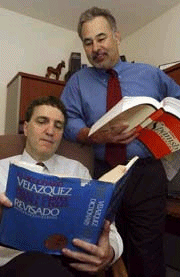
A Court Language Translator Service
A Custom & Production Cabinet Maker
ENTERPRISES BENEFIT BY DALE BRUDER'S COACHING ATTENTION
Abracadabra Restoration
Alarm Solutions
Andrew Avella
Arizona Audiotronics
Arizona House of Graphics
Arizona Open Land Trust
Asian Institute of Medical Studies
Asian Trade Rug Company
Arrow Land Survey
Atkinson's Cabinet Shop
Bio-Touch IFBM
Daniel H. O'Connell PC
Deed and NoteTraders
ELF Products
Empowering Local Communities
Focus Productions
Funzalo Records
Gadsden Company
Alex Holland
Jeff Hampton
Hi Tech Computers
Hosanna Electric
La Estancia LLC
MB Development
Maribelle Cakery
Mike's Artist Management
Pelstar Computers
Prime Home Services
Solar Transportation Technology
Sonoran Translators
Those Feng Shui Guys
Time & Time Again Antiques
Tres English
Tucson Embroidery & Design
Tucson Networking Association
Tucson Social Society
Unique Upholstery & Design Center
ARE EVOLVED, NOT BORN
The stages of leadership are varied and predictable. Varied in length because the actions a leader takes comes to fruition at different times. The stages are predictable because they follow an evolutionary lifecycle.
A leader who fails to grow into the next stage, grows too soon or too late can radically harm an enterprise - especially one they've created with their own blood, sweat and tears.
The first stage of leadership is dreaming. The dream can be anything ; bake the best tasting wedding cakes, make a plastic composite material that replaces plywood; provide translation services that offer a trained nuanced ear. The dream fires the passion that hardens the leader to begin the process of creating an enterprise that manifests their idea.
The next stage of leadership is becoming a founder. Founders bring their dream to fruition. This stage is short yet it's monumental. Like the Fool on the Tarot Card, the Founder steps off the cliff of all business is at risk and transforms into an Entrepreneur.
The Entrepreneur is a doer, an overachiever and a risk-taker. There is no time for either dreaming or structure. Moxie is all that's active towards establishing a business, raising money, penetrating markets and starting production. No time for meetings or planning.
The big question is 'Can I (the company) survive long enough for my product/service to grab a market niche.' It's a roller coaster ride for everyone who gets on. Proto types fail, key talent leaves, cash flow fluctuates wildly. The leader john waynes' it, taking bullets and arrows charging through.
The charismatic, extroverted entrepreneur is always reaching for the right set of circumstances that bring all the pieces together. Everything is a crisis all the time. Without the touch of a visionary, the entrepreneur becomes a tiresome liar with a string of broken promises.
Organizational accountability is missing. There is no place for a young MBA who is trained for a structured company, not a rodeo. It is no place for a seasoned CEO because they are experienced in managing people and projects, not starting fires.
This stage can last from one to three years.
When the market niche is secured, its time for the entrepreneurial stage to wind down. But the leader is often lacking in perspective and wisdom. They are addicted to the adrenaline of running off the cliffs, charging the breaches. With fanatic zeal they fight to retain their role as the one and only.
This behavior jeopardizes the survival of the enterprise and signals the need for radical intervention. Historically, many founder/entrepreneurs do not survive this transition. They don't have the genes to evolve into the next stage of leadership. The business either fails, limps along for years in this stage or is taken away from them. Unrepentant entrepreneurs regress to dreamers, found new enterprises and repeat the short lifecycle.
A leader who escapes the founder/entrepreneur trap enters a new world. Behavioral modeling: showing what the next stage is supposed to be rather than reinforcing the organizations existing style and behavior is the new challenge for the leader. Transforming the business into a stable, attractive enterprise is the new vision.
Time management techniques become attractive. Delegation and decentralization are recognized as necessary. An urgency appears to install systems and hire the right talent. The leader stops micro managing.
A business leader who passes through this gauntlet successfully is CEO material. Budgeting systems and expenditure controls are established.
A culture of decision making occurs replacing the former anarchy of the one and only leader/entrepreneur. Rules are established that make everything run more effectively. A culture of mutual respect and trust is nurtured to encourage the evolution. The leader walks the talk and create a new history of promise keeping and follow through. Fair rules, fairly enforced, introduce a new stability with universal benefit.
The essential goal of this arduous transition is a new culture that optimizes entrepreneurial energy by professionalizing the company with administration stability and operations (producer) strength.
Once the leader has grown to become a CEO quality executive and the company has calmed down to producing/selling/servicing the final stage of leader evolution appears.
The wild past of the dreamer, the visionary founder and the moxie of the entrepreneur that the leader fought so hard to vanquish needs to be resurrected and engaged. It's different now. The required leadership is not the hard work of producing results, of the hands-on manager. Nor is it false promises in the face of market barriers.
The leader is flexible and adaptable. A company culture exists that responds to challenges, not problems. Decisions are swift. Talent and resources are deftly applied.
Now, from a foundation of mastery and resources, the leader returns to being a dreamer; building a dynasty.
Leadership and Executive Coaching
Get an evaluation of your natural and developed strengths.
An organization is only as strong as its leader. From presidents to sports coaches to business owners, effective leadership reverberates throughout a group, setting the tone and supervising a system to ensure it meets its goals.
Like a conductor guiding an orchestra, a leader knows the ins and outs of the business -- the weaknesses in the brass section and strengths in the strings. With each motion and expression, a leader ensures the group hits the right notes and syncs in harmony.
For a small business owner, that harmony means loyal, capable employees, a productive process in place and a solid bottom line. Though leadership comes in all forms and styles, the best leaders share these characteristics:
- Vision
First and foremost, a leader has a long-term vision for
the company and strategy for accomplishing that vision.
- Dedication
Role models lead by example. A leader's dedication to a
company or project is contagious. Owners can only
expect as much dedication from their employees as
they're willing to give themselves.
- Charisma
It's easy to celebrate the good times. A strong leader maintains the same level of enthusiasm through good and bad, inspiring the team to stay motivated and excited about the end goal and forge through the rough spots.
- Communication
The relay of information and expectations is important
in any relationship -- especially for leaders, who must accurately and repeatedly convey the company's mission and goals and offer feedback to keep team members on track.
- Courage
It's the old adage: The only failure is not trying.
Leaders might swing and miss, but they swing again. And
again. And again. Self-doubt is often paralyzing.
- Intuition
The most effective leaders have the ability to sense a
problem, whether with the business, a project or an
employee. Addressing a concern before it turns into a full-fledged crisis is invaluable.
- Empathy
Ruling with an iron fist never makes for satisfied,
loyal employees. Treating everyone with the same level
of respect, understanding and concern ensures they will
do the same with their jobs and your business.Contact Dale Bruder 520-331-1956 for your executive leadership needs




Main Speaking & Seminars Tao Time Blog
All content copyright by Dale Bruder unless attributed to others ©2020
520-331-1956
FREE WORKSHEETS
Strategic Planning Series
ON LINE COURSES
Business Intelligence Seminar- Primary and Secondary Market Analysis in a New Economic Age
Ramp up on Shiatsu in five chapters, with Q&A. Entertaining and informative. Originally produced for Asian Institute of Medical Studies
Get Creative under construction
Dynamic Strategy getting this one ready to go. Watch it while under construction.
LINKEDIN GROUP
Chief Strategy Officer Discussion Group on Linkedin. Members are from all 4 global economic regions.
Engagements
Enterprise Warrior Training Becoming an Entrepreneurial Warrior
Business Coaching & Consulting - The business of business
Dynamic Professional Practice Create the environment that suits your ambition
Action Management Sprint, High Jump or Marathon Coaching
Meeting Facilitation Effective meetings by a master of Parliamentary Procedure
Strategic & Tactical Planning Approach your markets the way they want to be addressed
The Tao of Discipline Working at something until you can play at it
Executive Team Refresher Three Month Program to vitalize the A Team
Ongoing Advise and Consul - The Depth & Span of Mastery Contact Dale Bruder for a beginning consultation
PUBLISHED PAPERS
Action Management for the Next Business Upturn
Rethinking Your Value Proposition
NEWSLETTER ARCHIVES
 Coaching
Programs
Coaching
Programs Dale
Bruder's Blog
Dale
Bruder's Blog
 Tao
Time Programs
Tao
Time Programs Tao
Time Blog
Tao
Time Blog Published
 Seminars