TAO TIME
Composing An Inquiry of the Oracle

Main Twelve Branches Three Currents Lunar Hexagrams Tao Time Tao Blog
All content copyright by Dale Bruder unless attributed to others ©2023
The opportunity of applying the I Ching to an inquiry is done in a question. Preparing the question is done in a two step procedure. The clearer the question and the deeper your perception of the matters at stake, the more profound the answer will be. Form your question in eight words. Grammar is not a consideration.
Establishing the Field
The first step is to consider the matter. Search out the feelings, images and experiences involved. Articulate what you feel and think what you know and what you do not know. Look for relevant memories and experiences, hopes and fears, dreams and desires. Look to see what is there, no matter how contradictory. This will establish a field of associations that can focus the symbols and relate them to your concerns.
Formulating the Question
The second step is to formulate the question as clearly as possible. Base it on what you want to do. As you contemplate the question find the place where desire melts into uncertainty. As your inquiry deepens search out the level of specific you need. It does not matter what you are asking about as long as it is personally important and your motives in asking are sincere.
Yes and no questions are not usually effective. An effective formulation of a specific question might be: what about doing X? or What should my position about X be? If you are confused about the whole situation, you can ask the most basic question of the I Ching oracle: What time is it for me? Please give me an image of my overall situation. You can also ask for a strategy or guide: What is the most effective stance to take towards Y? How can I best achieve X? or How can I help A? If you are truly up against a dilemma, you can ask for an image of each alternative, formulating two questions: What about doing X? What about doing Y?
In formulating the questions, or asking about another person, you should be sure your motives are clear, straight and compassionate. Tradition says that the I Ching oracle will respond clearly to a real need but will not allow itself to be used for greedy or manipulative ends.
Position the Inquirer
Another thing to consider in posing a question is the position of the Inquirer. How is the person asking the question related to the matter at hand? In what way are they involved in the situation and what power do they have over the situation? Define who the Inquirer is by asking on behalf of: him or herself, as head of a family, as a therapist or healer, as manager or spokesperson for the group. The answers the oracle offers will be directly related to this position.
Active Dialogue
Applying the active dialogue form the basic question
can be reformulated into an action inquiry. This process applies what the
depth psychologist C.G. Jung called active imagination. It can lead to further
questions as you explore the matter you are considering in depth. Give the
oracle’s first response careful consideration. Where further questions
arise, do not hesitate to ask again. The I Ching oracle invites this sort
of dialogue.
The basic question you ask can be focused and make better sense by asking
a guide. As you contemplate the guide can lead you to connect to the situation,
what you can do now. You can then ask a From Now question.
The path followed in the 12 Branches process of long range planning is to progress the hexagram to it's nuclear as the image provided by the oracle in the begetting becoming begoning triad.
The one called Dale Bruder, is among the cultural innovators who have devised implements and techniques to use the I Ching in describing and predicating elements, processes and experiences in practices involving special uses of the mind and body.
The Tao Time Master
Communication Links Voice/Text 520.331.1956 taotime@dalebruder.com
1976
Sojourn Currents of the Occurring Worlds
Dale Bruder is a life student of the Tao through the I Ching. Since 1976 he has been applying the I Ching to his self the way psychoanalysts and Zen teachers apply psychoanalysis or Zen to themselves before presenting to others.
His studies of Taoist, Buddhist and Confucian I Ching texts towards mastery of the 'hall of mirrors at the end of a giant kaleidoscope' continues today. His intellectual journey is to match the complexity of ordinary real life with total coherence of the three views of Chinese thought.
Life is cyclical and sequential; a series of events and episodes that advances or reverses goals and aspirations.
Making use of and learning from the experience is a key component of a well lived life. Using the Tao Time path changes the social, cultural, technological and economic push/pulls into a flow that is navigable.
Dale Bruder, a business intelligence consultant, invites you to play the infinite game.
(520) 331-1956
Newsletters
The I Ching is a Proven Guide to Success
Next Transformative Tao
Begins on the New Moon
contact the TaoTime Master for location and time.
Begin a personal conversation with the I Ching oracle on this day before the New Moon. Continue your conversation for 72 Days in a Transformative Tao experience. Transformative Tao Sojourn $90
520-331-1956 or email to Begin Your Transformative Tao InquiryWhen you can discern changes, the I Ching becomes available to you.
EngagementsTransformative Tao Seventy-Two DaysThree Currents Inquiry - A three hour inquiry and consultation that takes Eighteen days to play out
What Time is It For Me? A one hour inquiry and consultation that calls you to live the answer for Six days
Tao Time Book of Days A daily journal beginning on January 22, 2023 continuing through the year
Topical Papers
Tao Time
The ecstasy of timelessness as Begetting, Becoming, Begoning is embodied in Tao Time.
Formulated 3,500 years ago in 64 interactive social and cultural messages about human and social interactions,
The IChing adapts and flexes shape in processes and procedures to navigate the means and matters that flow.
Through observation, detail and predication the IChing channels timeless energies. Following the forms of evolving and devolving leads to an ideal state of being. This is TaoTransformative Tao is one of those instruments. The 72 day sojourn between two and a half lunar cycles builds and releases energy creating momentum in realizing the appropriate manifestation of an inquiry made of the oracle.
Transformative Tao is a 14 part seminar on understanding and applying intentionally called actions.Through a methodological use of the IChing, or the Book of Changes,one can access and apply the wisdom in current times.
Applying the wisdom of the Tao, or the Way, always brings you exactly what you need when you need it to stay successful no matter the circumstances. Everything is useful in the Tao.
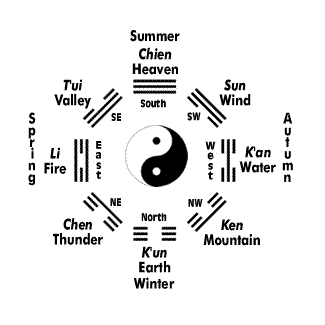
The Oracle is the I Ching, a construction of eight trigrams that form a combination of sixty four hexagrams that describes humans social and cultural activities.
 The
Art of Tao Time
The
Art of Tao Time
 Published
 Seminars
 Twelve
Branches
Twelve
Branches
 What
Time Is It?
What
Time Is It? Lunar
Book of Days
Lunar
Book of Days